easy home workouts

Finding the time and motivation to commute to a gym, navigate crowded weight rooms, and figure out complicated machines can be completely overwhelming for anyone with a busy schedule. For many people, the sheer friction of the traditional gym experience is the single biggest barrier to achieving their health and wellness goals. Fortunately, building strength, improving cardiovascular health, and boosting your daily energy levels does not require a costly membership or specialized gear. Embracing easy home workouts is a highly effective, realistic way to take control of your physical well-being directly from the comfort of your living room.
By focusing on fundamental movement patterns and utilizing your own body weight for resistance, you can create a sustainable and adaptable fitness routine. Exercising at home completely eliminates travel time, removes the intimidation factor of public gyms, and allows you to move at a pace that feels genuinely comfortable for your current fitness level. Whether you are a complete beginner taking your first steps toward a healthier lifestyle or a busy professional trying to squeeze in movement between remote meetings, learning how to exercise effectively in your own space creates a lasting foundation for lifelong health.
The Science and Benefits Behind Exercising at Home
One of the most significant advantages of performing easy home workouts is the unparalleled convenience they provide to your daily schedule. When your dedicated workout space is just down the hallway, traditional excuses regarding rush hour traffic, inclement weather, or forgotten gym bags simply vanish. This immediate accessibility makes it exponentially easier to build consistency, which is the absolute foundational pillar of any successful fitness journey. Consistent, moderate bodyweight exercise yields far better long-term results than sporadic, intense gym sessions that leave you too exhausted to move for days.
Furthermore, training at home provides a completely private, judgment-free environment where you can focus entirely on your physical form and your body’s feedback. Many beginners feel incredibly self-conscious when attempting new movements or exploring unfamiliar routines in front of seasoned gym-goers. In the security of your own living room or bedroom, you have the absolute freedom to modify exercises, take longer rest periods if your body demands it, and learn the mechanical capabilities of your muscles without any external pressure. This psychological safety heavily encourages better adherence to your new physical routine.
Financially, relying on bodyweight exercises and minimal-equipment routines makes physical health accessible and equitable for everyone. You do not need to invest in expensive commercial treadmills, heavy dumbbell racks, or premium monthly subscription fees to see tangible physical changes in your physique and stamina. Your muscles do not know the difference between a high-end gym machine and the natural resistance provided by gravity. By intelligently leveraging your own body weight, you can effectively challenge your cardiovascular system and muscular endurance completely free of charge.
Preparing Your Space and Mindset for Home Fitness
Before diving directly into physical exertion, creating a dedicated and safe environment for your easy home workouts is a crucial preparatory step for long-term success. You do not need a massive finished basement or a fully converted garage to get a highly effective workout. A small, clear space in your living room, just wide and long enough for you to lie down completely with your arms outstretched, is more than sufficient. Clearing away everyday clutter, shifting the coffee table, and ensuring you have a safe, non-slip floor surface will prevent accidental injuries and make the designated area feel intentionally designed for movement.
Mental preparation and boundary setting are just as important as arranging your physical space. When you are at home, the psychological boundary between relaxation time, household chores, and exercise time can easily become blurred and confusing. It helps immensely to establish a consistent pre-workout ritual that clearly signals to your brain that it is time to focus exclusively on fitness. This could be as simple as changing into proper activewear, filling up a dedicated water bottle, and putting on a specific, upbeat music playlist. Treating your home workout with the exact same respect you would give a scheduled professional appointment ensures you actually follow through with your plans.
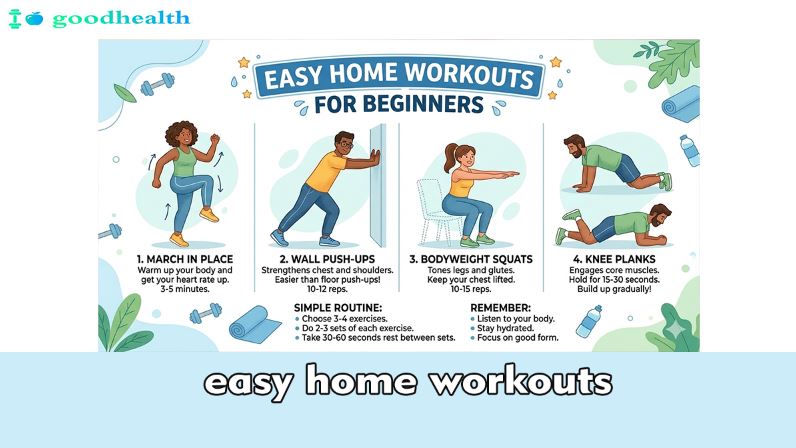
Properly warming up your muscular system is the final mandatory preparation step before jumping into the core of your fitness routine. At home, people often make the critical mistake of going directly from sitting rigidly on the office chair straight into intense squats or demanding push-ups. Taking just three to five minutes to perform dynamic stretches, such as wide arm circles, gentle torso twists, and energetic marching in place, dramatically increases blood flow to your muscles and safely lubricates your joints. A thorough, deliberate warm-up drastically reduces the risk of painful muscle strains and significantly improves your overall performance during the workout.
Fundamental Movements for an Effective Routine
When designing easy home workouts, the most effective approach is to focus on foundational human movement patterns rather than isolating tiny, specific muscles. The human body is designed to push, pull, squat, hinge, and carry. By incorporating exercises that recruit multiple large muscle groups simultaneously, you maximize your caloric burn and build practical, functional strength that translates directly into making your daily life easier. Structuring your routine around compound movements guarantees that you are getting the absolute highest return on investment for your time spent exercising.
Breaking your routine down into specific physical regions helps ensure that your body is developing symmetrically and that no major muscle group is being neglected. A well-rounded home fitness plan will always include a balance of lower body strength, upper body pushing and pulling, and dedicated core stabilization. Approaching your workout with this structured methodology prevents the common beginner mistake of only training the muscles that are easily visible in the mirror, which often leads to severe posture issues and muscular imbalances over time.
Lower Body Basics for Strength and Stability
The lower body houses the largest, most powerful muscle groups in your entire physique, including the glutes, quadriceps, and hamstrings. Engaging these massive muscles through targeted bodyweight exercises is an excellent way to build functional power and elevate your heart rate rapidly. The foundational movement for lower body strength is the classic bodyweight squat. When performed correctly, squats precisely mimic the natural, everyday motion of sitting down in a chair and standing back up. Keeping your chest lifted proudly, pushing your hips backward, and ensuring your knees track cleanly in line with your toes will help you maximize the muscular benefits while thoroughly protecting your delicate knee joints.
Lunges serve as another phenomenal lower body exercise that significantly challenges your balance, physical coordination, and unilateral leg strength. By stepping gracefully forward or backward and bending both knees to approximately ninety-degree angles, you isolate and fatigue each leg individually. This targeted approach helps correct the natural muscle imbalances that occur when we subconsciously favor one side of our body over the other during daily tasks. If standard unassisted lunges feel too difficult or unstable initially, gently holding onto a sturdy dining chair or a solid kitchen counter for balance support is an excellent, highly recommended modification.
Upper Body Conditioning Without Heavy Weights
Many fitness beginners mistakenly believe that building noticeable upper body strength absolutely requires lifting heavy iron or using complicated cable machines, but your own body weight naturally provides more than enough heavy resistance to stimulate genuine muscle growth. The classic floor push-up remains the undisputed gold standard for upper body home fitness. It comprehensively targets the chest, front shoulders, and triceps all at the same time. To perform a standard push-up with utmost safety, keep your hands positioned slightly wider than shoulder-width apart and maintain a rigid, completely straight plank-like line from the top of your head down to your heels as you smoothly lower and press your body upward.
If a full, unassisted push-up from the floor is currently out of reach, there are effective, proven ways to modify the movement without losing its profound benefits. Wall push-ups act as an excellent, highly accessible starting point; by standing just a few feet away from a blank wall and pressing your flat hands against it, you drastically reduce the percentage of your total body weight that you have to lift. As your upper body strength predictably increases, you can strategically progress to elevated push-ups by utilizing a sturdy kitchen countertop or the firm edge of a heavy living room sofa.
Core Exercises for Posture and Spinal Health
A robust, highly developed core is the literal physical foundation of all human movement, acting as the vital central bridge transferring power between your upper and lower body. When incorporating core exercises into your easy home workouts, your primary goal should always be strict stability and absolute control rather than performing hundreds of aggressive, high-speed abdominal crunches. The static forearm plank is arguably the single most effective isometric core exercise available to anyone. By resting your body weight entirely on your forearms and toes while keeping your torso perfectly straight and tense, you aggressively force your deep abdominal muscles, side obliques, and lower back to work in perfect harmony to resist gravity.
For actively targeting the abdominal wall with safe motion, dead bugs are an incredibly potent and highly recommended exercise. Lying flat on your back with your arms pointing straight up toward the ceiling and your knees bent at sharp ninety-degree angles, you slowly, deliberately lower one arm and the opposite leg simultaneously toward the floor. The strict, non-negotiable rule of this specific exercise is that your lower back must remain firmly glued to the floor surface at all times. This mindful, highly deliberate movement requires intense mental concentration and builds incredibly deep core strength without placing any stressful, dangerous loads on the sensitive cervical spine or neck region.
Structuring a Highly Efficient 15-Minute Home Workout
One of the greatest and most pervasive misconceptions about the fitness industry is that you must work out for an hour or more every single day to see meaningful, lasting physiological changes. In reality, a deeply focused, intensely executed 15-minute home workout can deliver truly outstanding cardiovascular and muscular endurance benefits. The hidden secret to this efficiency lies in carefully structuring your routine as a continuous circuit. Circuit training involves deliberately performing a sequence of different exercises back-to-back with only the absolute minimum required rest in between. This elevated pacing keeps your heart rate continuously high, effectively turning a simple strength building session into a highly potent fat-burning workout.
To properly design a basic, full-body beginner circuit, you should intelligently select four or five distinct exercises that target completely different major muscle groups. For instance, you might specifically choose to combine deep bodyweight squats, elevated incline push-ups, alternating reverse floor lunges, and a static forearm plank. You will perform the first exercise for exactly forty seconds, focusing entirely on clean, highly controlled physical form rather than recklessly rushing to complete as many sloppy repetitions as possible. Once the forty-second work period is completely up, you take a strict twenty-second rest and transition period to catch your breath and immediately move into the proper starting position for the next exercise.
Completing one full, unbroken round of these selected exercises will take approximately four to five minutes of your time. By purposefully resting for one full, uninterrupted minute at the very end of the completed round and then aggressively repeating the entire physical circuit two more times, you instantly create a comprehensive, exhausting, and highly efficient daily workout. This specific style of interval training is incredibly flexible and highly responsive to your needs. As your baseline cardiovascular fitness naturally improves over the weeks, you can easily adapt the routine by extending the active work intervals to fifty seconds, decreasing the vital rest intervals, or creatively swapping in much more challenging exercise variations.
Overcoming Common Mistakes in Bodyweight Training
When initially transitioning to easy home workouts, enthusiastic beginners very often fall into a few highly predictable physical traps that can severely stall their overall progress or lead to unnecessary, painful joint discomfort. The absolute most prevalent mistake is dangerously prioritizing the total quantity of repetitions over the strict quality of the movement being performed. Bouncing rapidly and uncontrollably through thirty sloppy, half-depth squats might momentarily feel like a great cardio workout, but it completely fails to properly stimulate the leg muscles and puts highly excessive, dangerous shear force on the delicate knee joints. Slowing down the entire movement, strictly controlling the downward descent, and intentionally focusing on the specific muscle contraction yields vastly superior physical results.
Another incredibly frequent error is failing to maintain a consistent, rhythmic breathing pattern during physical exertion. It is incredibly common for inexperienced people to unconsciously hold their breath during the absolute most challenging part of an exercise, such as violently pushing up from the floor or struggling to stand up from a deep lunge. This sharply and dangerously spikes internal blood pressure and quickly leads to immediate dizziness and premature muscular fatigue. A highly effective general rule of thumb to follow is to inhale deeply and smoothly during the eccentric, or lowering, phase of any exercise, and exhale forcefully and loudly during the concentric, or pushing, phase.
Finally, many highly motivated individuals completely neglect the supreme importance of adequate rest and physical recovery when training exclusively at home. Because zero-equipment bodyweight workouts are so incredibly convenient, there is a massive temptation to perform them intensely every single day of the week. However, human muscles do not actually grow stronger while you are actively exercising; they solely grow stronger and repair themselves during the vital recovery periods between your physical sessions. Chronic overtraining rapidly leads to persistent daily fatigue, deep joint aches, and a severe, sudden drop in mental motivation. Committing to three or four perfectly executed workouts per week, separated by active rest days of light walking or gentle stretching, is the scientifically optimal path for sustainable progress.
Advancing Your Fitness Without Purchasing Equipment
As you remain highly consistent with your easy home workouts, your body will inevitably adapt to the physical stress, and the exercises that once felt incredibly difficult will gradually start to feel highly manageable. To continuously make physical progress without stalling, you must strictly apply the core fitness principle of progressive overload. While traditional gym-goers achieve this simply by adding heavier weight plates to a steel barbell, home fitness enthusiasts can ingeniously achieve the exact same physiological response by intelligently manipulating other physical variables. One of the absolute simplest and most effective methods is heavily increasing the total time under tension. By purposefully and painfully slowing down each individual repetition, particularly the lowering phase, you actively force your muscle fibers to work significantly harder and recruit more stabilizing muscles.
Another excellent strategy for continuous physical progression is smartly altering the physical leverage and mechanical disadvantage of the specific exercises you perform. Once you have fully mastered standard, two-legged squats, you can confidently transition to deep split squats or even attempt highly advanced assisted single-leg squats to dramatically increase the heavy load on each individual leg. Similarly, securely elevating your feet on a sturdy dining chair during floor push-ups aggressively shifts significantly more of your own body weight directly onto your upper chest and front shoulders, creating a vastly more intense muscular stimulus. These highly subtle, geometric physical adjustments ensure that your bodyweight routine heavily remains challenging and highly effective for many months and years to come.
Incorporating highly explosive, dynamic plyometric movements is the absolute final frontier for massively advancing your home fitness routine. Once you have successfully built a highly solid foundation of baseline strength and deep joint stability, adding a small, explosive jump to the very top of your squats or alternating lunges transforms the basic exercise entirely. Plyometrics require your fast-twitch muscle fibers to heavily exert maximum physical force in incredibly short intervals, which builds highly impressive athletic power and absolutely torches bodily calories. However, these demanding, dynamic movements should always be introduced very gradually and consistently performed on highly forgiving surfaces to perfectly protect your joints from heavy, repeated physical impact.
Achieving Lasting Results Through Home Fitness
Sustaining a healthy, active lifestyle does not require you to conform to the traditional, often intimidating gym culture that dominates the modern fitness industry. By fully committing to a structured program of easy home workouts, you empower yourself to take absolute control of your physical health on your own terms and within your own schedule. The sheer simplicity of utilizing your own body weight completely strips away the common logistical barriers that so frequently derail well-intentioned fitness journeys. When you remove the long commutes, the expensive monthly fees, and the reliance on highly complex machinery, fitness transitions from being a burdensome daily chore to an accessible, highly rewarding daily habit.
The true secret to unlocking the incredible benefits of exercising at home is maintaining unyielding consistency and focusing relentlessly on the quality of your physical movements. Transforming your living room into a functional space for physical self-improvement fundamentally shifts your relationship with exercise. You begin to view movement not as a punishment for what you ate, but as a dedicated celebration of what your body is physically capable of achieving. Over time, the strength and elevated endurance you carefully build in the strict privacy of your own home will naturally radiate outward, profoundly enhancing your daily energy levels, your physical posture, and your overall mental clarity.
Ultimately, the absolute best workout routine is simply the one that you can confidently and realistically stick with over the long term. Bodyweight training offers an infinitely scalable, highly adaptable pathway to robust physical health that precisely meets you exactly where you currently are. By thoughtfully embracing the fundamental movements, properly prioritizing adequate rest, and continuously challenging your muscles through strategic progressive overload, you guarantee your own success. Mastering your physical fitness from home is a highly profound investment in your long-term well-being, proving once and for all that everything you truly need to build a stronger, healthier body is already right there with you.
Can I actually lose weight and get fit with just home workouts?
Yes, consistently doing bodyweight exercises and keeping your heart rate up can effectively burn fat and build strength without stepping foot in a gym.
What are the best equipment-free exercises for total beginners?
Start with simple, joint-friendly movements like bodyweight squats, knee push-ups, reverse lunges, and short plank holds to build a solid foundation safely.
How many days a week should I work out at home to see results?
Aiming for three to four days a week is the sweet spot, keeping you consistently active while giving your muscles the necessary time to recover.
How long does a beginner home workout need to be to be effective?
Even a focused 15 to 20-minute circuit is completely enough to elevate your heart rate, break a solid sweat, and start seeing real physical changes.
How can I stay motivated to exercise at home when I lack energy?
Treat your workouts like unbreakable appointments, commit to just the first five minutes, and usually, your energy will naturally kick in once you start moving.
Please note
The content provided in this article is for educational and informational purposes only and should not be construed as medical, nutritional, or therapeutic advice. The recommendations provided may not be appropriate for everyone. The final decision regarding your health and lifestyle is yours, and we recommend that you consult with your doctor or other health professional before making any changes or taking any action.