How to get better at any skill

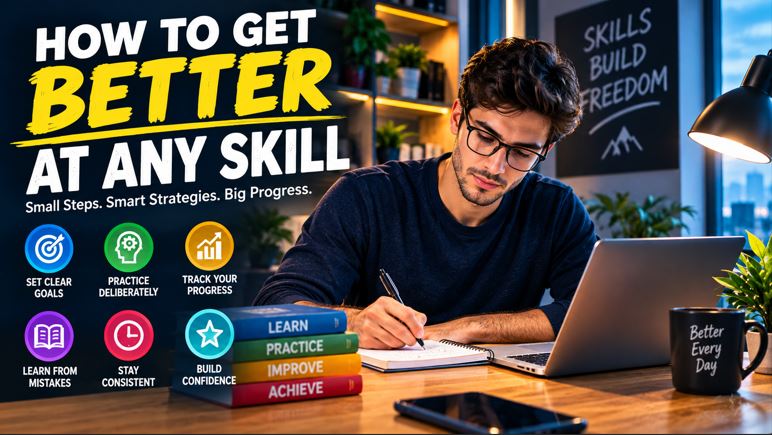
Learning a new skill can transform your personal and professional life. Whether you want to improve communication, writing, design, programming, fitness, business, creativity, music, or another ability, progress comes from deliberate practice, patience, and a willingness to learn from mistakes. The good news is that you do not need to be naturally talented to improve. With the right strategy and consistent effort, you can become significantly better at almost any skill.
Understanding how to get better at any skill starts with changing the way you approach learning. Instead of expecting instant results, focus on steady improvement, purposeful practice, feedback, and long-term consistency. When you develop an effective learning system, even difficult skills become more manageable.
Define the Skill You Want to Improve
The first step in learning how to get better at any skill is defining exactly what you want to improve. A broad goal such as “I want to get better at business” is difficult to measure because it contains many different abilities.
Break the skill into specific components. For example, becoming better at public speaking may involve improving confidence, voice control, storytelling, body language, organization, and audience engagement.
The more specific your goal, the easier it becomes to identify what to practice.
Set a Clear Learning Goal
A clear goal gives your practice direction. Instead of simply trying to “improve,” decide what you want to be able to do.
For example, you might want to write a professional article, complete a specific design project, hold a five-minute conversation in another language, or perform a particular exercise correctly.
Specific goals make progress easier to observe and give you a clear reason to continue practicing.
Break Complex Skills Into Smaller Parts
Most valuable skills are actually combinations of smaller skills. Trying to master everything at once can quickly become overwhelming.
Break the skill into manageable pieces and practice them individually. Once each component becomes more comfortable, combine them into more complex tasks.
This approach allows you to identify weaknesses more easily and spend more time practicing the areas that need the most improvement.
Practice Consistently
Consistency is one of the most important factors in skill development. Practicing occasionally can help you learn, but regular practice gives you more opportunities to strengthen your abilities.
You do not necessarily need to practice for many hours every day. A shorter, focused session performed consistently can be more sustainable than occasional marathon sessions.
Create a realistic routine that fits your schedule. The goal is to make practice a regular part of your life.
Focus on Deliberate Practice
Simply repeating an activity does not always lead to improvement. Effective practice requires attention to the areas where you need to improve.
Deliberate practice means working on specific weaknesses, performing tasks with concentration, and paying attention to errors.
For example, a person learning writing could focus on improving introductions one day, sentence structure another day, and editing techniques later. Each session has a specific objective rather than simply producing more words.
This focused approach can make learning more efficient.
Learn From Your Mistakes
Mistakes are a natural part of skill development. Instead of seeing errors as proof that you are not talented, use them as information.
Ask yourself what went wrong, why it happened, and what you can do differently next time.
The ability to identify and correct mistakes can accelerate learning because each error becomes an opportunity to improve your technique.
Get Feedback
Feedback can reveal problems that are difficult to notice on your own. A teacher, mentor, coach, colleague, or experienced friend may be able to identify weaknesses and suggest improvements.
When receiving feedback, focus on specific recommendations rather than taking criticism personally.
Useful feedback should help you understand what you are doing well, what needs improvement, and what you can practice next.
Study People Who Are Already Good at the Skill
Observation can be a powerful learning tool. Study how experienced people approach the skill you want to master.
Read their work, watch demonstrations, examine their techniques, and pay attention to how they solve problems.
Do not simply copy the final result. Try to understand the process behind it.
Learning from experienced people can help you discover methods that may take much longer to develop through trial and error alone.
Understand the Fundamentals
Strong fundamentals provide a foundation for advanced performance. Many people rush toward complicated techniques before mastering the basics.
Whether you are learning photography, coding, drawing, fitness, cooking, or communication, fundamental principles matter.
Spend enough time understanding the core concepts. Once the basics become reliable, more advanced techniques become easier to learn.
Challenge Yourself Gradually
Improvement requires a level of difficulty that pushes you beyond your current ability without becoming completely overwhelming.
If a task is far too easy, you may not learn much. If it is far beyond your current level, you may become frustrated and lose motivation.
Gradually increase the difficulty as your abilities improve. This creates a progression in which you are continually developing new capabilities.
Avoid Multitasking While Practicing
Concentration is essential for effective learning. Constantly checking your phone, responding to messages, or switching between unrelated activities can reduce the quality of practice.
Create a distraction-free environment when possible. Put your attention on the task and practice with intention.
Even a relatively short period of focused practice can be valuable when you are fully engaged.
Use Active Learning
Active learning involves doing rather than simply consuming information.
Reading a book about a skill can be useful, but applying the information is what develops practical ability. Write something, solve a problem, build a project, perform the exercise, speak the language, or demonstrate what you have learned.
The more actively you use information, the more opportunities you have to identify gaps in your understanding.
Keep a Record of Your Progress
Tracking your progress can make improvement more visible. Keep a notebook, spreadsheet, journal, or digital record of your practice.
Record what you practiced, what was difficult, what improved, and what you plan to work on next.
Over time, this record can show how far you have progressed, even when daily improvements seem small.
Use Projects to Apply What You Learn
Projects are an excellent way to turn knowledge into practical skill. Instead of practicing individual techniques forever, use them to create something meaningful.
A writer might create a complete article. A designer might build a portfolio project. A programmer might develop a small application. Someone learning marketing might create and analyze a real campaign.
Projects force you to combine multiple abilities and solve problems that isolated exercises cannot always reproduce.
Develop Patience
Skill development takes time. One of the biggest obstacles is expecting dramatic improvement too quickly.
You may practice for weeks without noticing major changes, followed by a period when your abilities suddenly seem much better.
Learning is not always a smooth upward line. Progress can involve periods of frustration, plateaus, experimentation, and breakthroughs.
Patience allows you to continue practicing when improvement is difficult to see.
Build a Growth Mindset
Your beliefs about learning can influence how you respond to difficulty. Instead of thinking, “I am not good at this,” consider asking, “What do I need to practice to become better?”
This shift encourages curiosity and persistence. A difficult task becomes a challenge to solve rather than evidence that you should quit.
A growth-oriented approach can help you remain engaged during periods when progress feels slow.
Focus on Quality, Not Just Quantity
More practice is not automatically better practice. Repeating mistakes for hours can reinforce poor technique.
Pay attention to how you practice. Slow down when necessary, correct errors, and make sure you understand what you are doing.
A shorter practice session with a clear objective may produce more learning than a long session performed without concentration.
Use Rest and Recovery
Rest is an important part of learning. Your brain needs time to process and consolidate information, while physical skills often require recovery between demanding sessions.
Avoid assuming that nonstop practice will always produce faster results.
Create a sustainable routine that includes breaks, sleep, and recovery. Consistency becomes much easier when your learning process does not constantly exhaust you.
Embrace Plateaus
Almost everyone experiences periods when progress seems to stop. These plateaus can be frustrating, but they are a normal part of skill development.
When progress slows, consider changing your practice method, increasing the difficulty, seeking feedback, reviewing fundamentals, or focusing on a different component of the skill.
A plateau does not necessarily mean that you are failing. It may simply mean that your current approach needs adjustment.
Teach What You Learn
Teaching someone else can strengthen your own understanding. Explaining a concept requires you to organize information and identify gaps in your knowledge.
Try explaining a technique to a friend, writing a tutorial, making notes in your own words, or demonstrating what you know.
Teaching can turn passive knowledge into deeper understanding.
Stay Curious and Keep Learning
The best learners remain curious. Continue asking questions, exploring new approaches, and looking for better ways to practice.
As your skill improves, your questions will often become more sophisticated. Instead of asking only how to perform a task, you may begin asking why a particular method works and when another method would be better.
This curiosity can keep skill development interesting for years.
Apply the Skill in Different Situations
Transfer is an important part of mastery. A skill should not only work in one familiar environment.
Practice using what you know in different situations, under different constraints, and with different problems.
For example, someone learning communication should practice with different audiences and subjects. Someone learning design should work on different formats and styles.
Flexible application demonstrates deeper understanding.
Make Practice a Habit
Motivation can change from day to day, but habits can provide structure when motivation is low.
Choose a regular time, create a simple practice routine, and make it easy to begin. Even when you are not particularly motivated, completing a small amount of practice keeps the habit alive.
Over time, regular practice can become part of your normal routine rather than something you constantly have to force yourself to do.
Measure Improvement in Meaningful Ways
Do not measure progress only by the amount of time you spend practicing. Look at actual performance.
Can you complete the task more accurately? Are you working faster without sacrificing quality? Can you solve more difficult problems? Are you making fewer mistakes?
Useful measurements connect practice to real improvement.
Conclusion
Learning how to get better at any skill is a process built on clear goals, focused practice, feedback, patience, and consistent application. Talent can influence where someone starts, but improvement depends heavily on what they do after they begin.
Break large skills into smaller components, master the fundamentals, practice deliberately, learn from mistakes, seek feedback, and gradually increase the challenge. Most importantly, give yourself enough time to improve.
Ultimately, how to get better at any skill comes down to developing an effective learning system and following it consistently. Whether you are developing a professional ability, a creative talent, a physical skill, or a personal capability, small improvements repeated over time can lead to remarkable results.
What is the fastest way to get better at a skill?
There is no universal shortcut. A highly effective approach is to define the skill clearly, practice specific weaknesses, get regular feedback, learn from experienced people, and apply what you learn through real tasks or projects.
How long does it take to become good at a new skill?
The time varies greatly depending on the complexity of the skill, your starting ability, practice quality, consistency, and available time. Simple skills may improve relatively quickly, while advanced skills can require years of practice.
Is natural talent necessary to master a skill?
Natural differences can affect how quickly people learn certain abilities, but talent is not the only factor. Consistent practice, effective learning methods, feedback, and persistence can produce substantial improvement.
How many hours should I practice each day?
There is no single ideal number of hours. The quality of practice matters greatly. A manageable amount of focused practice that you can sustain consistently is often more useful than long sessions that lead to exhaustion or poor concentration.
What should I do when I stop improving?
Review your practice method, identify specific weaknesses, seek feedback, revisit the fundamentals, and introduce new challenges. Changing your approach can help you move beyond a plateau and continue developing your ability.
please note
The content provided in this article is for educational and informational purposes only and should not be construed as medical, nutritional, psychological, or therapeutic advice. The advice provided may not be appropriate for everyone. The final decision regarding your health and lifestyle is yours, and we recommend that you consult with your doctor, counselor, or other health professional before making any changes or taking any action.
Our latest and greatest
-

Emotional Advantage
€0.00 -
Healthy Life Blueprint
€0.00 -
How to break negative habits
€0.00 -
How to have continuity
Original price was: €4.90.€0.00Current price is: €0.00. -
Living with Purpose
Original price was: €8.90.€0.00Current price is: €0.00.